Brunel’s Last Photograph, 1859
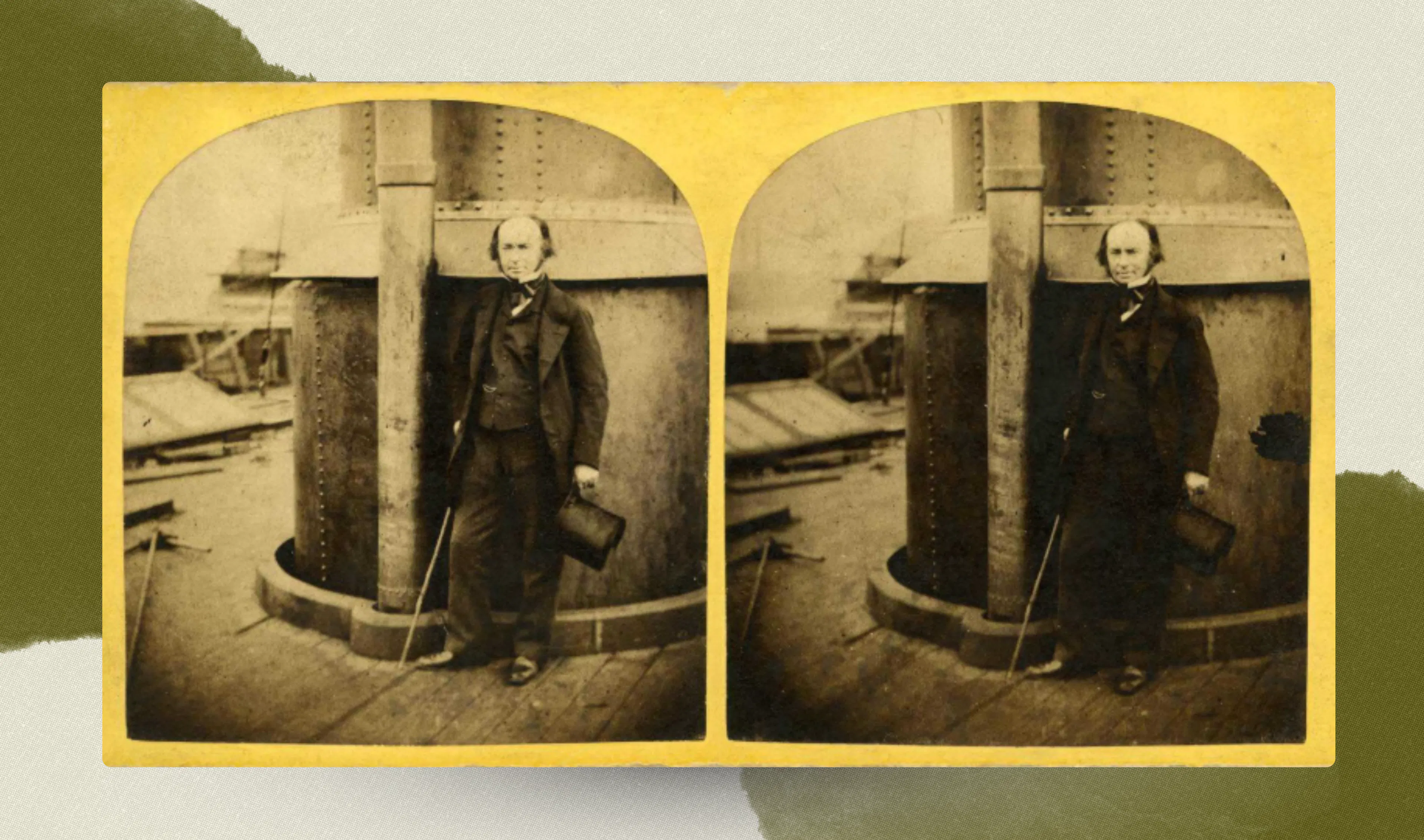
Brunel’s Last Photograph, 1859
The picture
This photograph shows Isambard Kingdom Brunel making a final visit to his ship, the SS Great Eastern, on 5 September 1859. It is one of only eight known photographs of Brunel and the last image taken of him before his death.
Brunel is shown holding a walking stick and appears visibly unwell, a striking contrast to the well‑known photograph taken two years earlier of him standing confidently beside the ship’s massive launch chains. By 1859, Brunel’s health had been severely affected by the strain of working on his most ambitious and troubled project.
The photograph appears twice because it was produced as a stereoscopic card. When viewed through a stereoscope — a popular Victorian device — the paired images created a three‑dimensional effect, bringing famous people and scenes vividly to life.
Just ten days after this photograph was taken, Brunel died, making the image a powerful and poignant record of the engineer at the end of his life.
Brunel and photography
By the late 1850s, photography was becoming increasingly popular, and more people were having their portraits taken. Members of the public could also purchase photographs of famous individuals, landmarks and major engineering works, reflecting widespread interest in technological progress.
Images of Brunel and the SS Great Eastern were widely reproduced, both as photographs and as engraved illustrations printed in newspapers.
These photographs were often carefully staged. Brunel was keenly aware of his public image and took an active role in how he was presented, particularly in photographs that might be widely circulated.
A problem project
The SS Great Eastern was Brunel’s final and largest ship, measuring nearly 700 feet (214 metres) in length. To power this vast vessel, Brunel combined two large paddle wheels with a screw propeller, driven by separate engines.
Built in London, the ship was plagued by difficulties from the outset. Launching her into the River Thames proved exceptionally challenging, with several failed attempts before she finally floated on 31 January 1858. The project also proved far more expensive than originally planned.
Disaster struck during preparations for sea trials scheduled for 7 September 1859. In the rush to complete the ship, two temporary stopcocks on the funnel heaters were mistakenly left in place, causing a funnel explosion that killed five people. Brunel, already in poor health, was deeply affected by the news.
On 5 September 1859, the day this photograph was taken, Brunel suffered a stroke on board the ship shortly after having his photograph taken. He was taken home as the SS Great Eastern set sail without him. He died ten days later, on 15 September 1859, aged 53.
A ship ahead of its time?
When launched in 1858, the SS Great Eastern was the largest ship in the world and among the most expensive ever built. Brunel designed her to carry 4,000 passengers to Australia while holding enough coal to make the journey there and back without refuelling.
In practice, the ship never sailed to Australia and struggled to operate profitably on routes to New York, rarely carrying enough passengers to justify her immense running costs.
Despite these challenges, the ship later found a new purpose. In 1865, the SS Great Eastern was used to lay the first successful transatlantic telegraph cable, dramatically improving global communication and securing her place in technological history.