Passenger Rachel Henning’s Diary, 1861
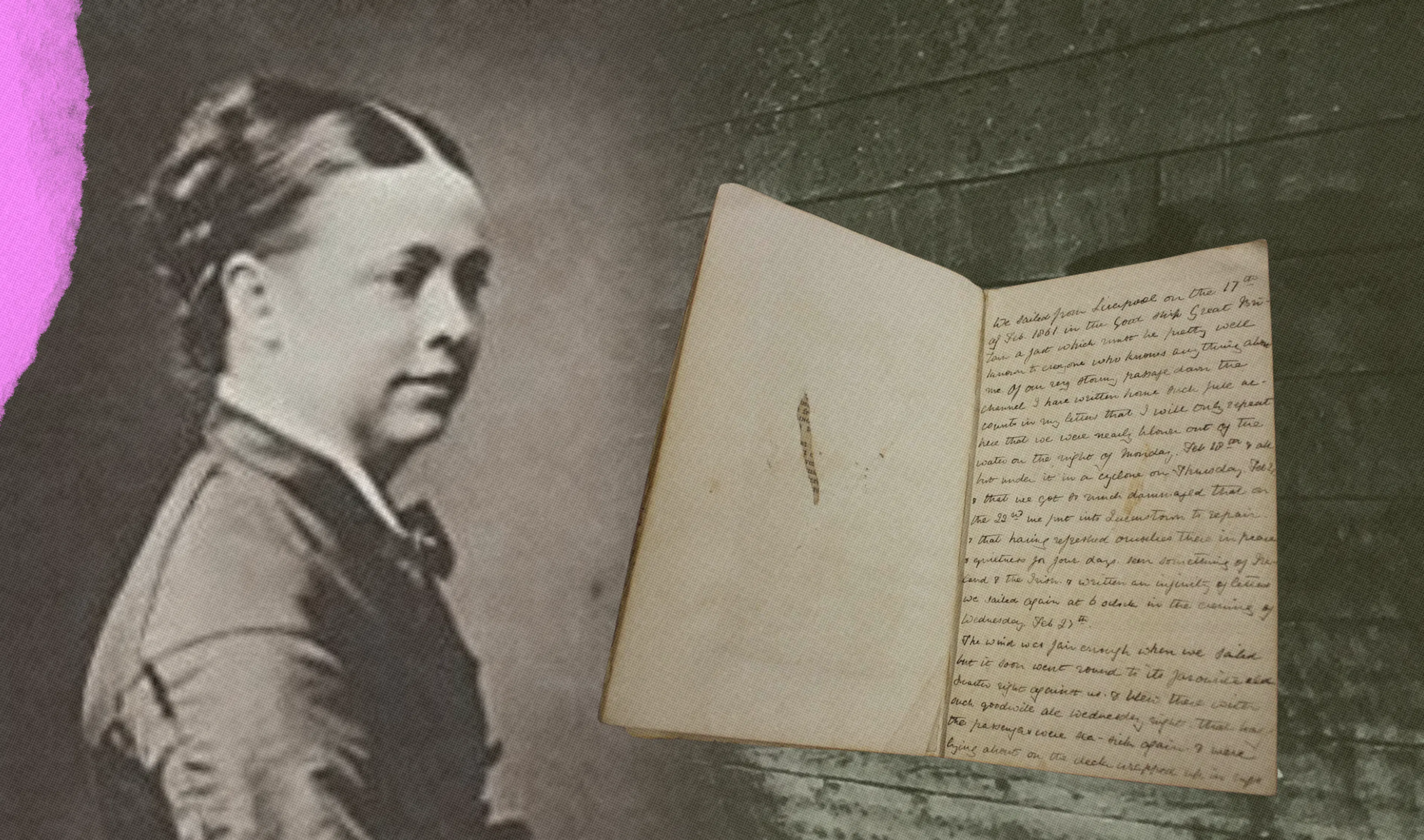
The object
This diary was written by Rachel Henning during her voyage from Liverpool to Melbourne aboard SS Great Britain in 1861.
Travelling as a First Class passenger, Rachel recorded daily life on board, describing how she passed the time playing games, reading, sewing and exploring the ship. She also wrote candidly about fellow passengers and crew, noting those she admired, such as Captain Gray, and others she found more difficult. Her diary records important moments from the voyage, including births and deaths at sea.
The journey marked Rachel’s second emigration to Australia. Born in Somerset, she had previously lived in Australia between 1854 and 1856, but returned to Britain after finding it difficult to adjust. By February 1861, she decided to make the journey again, travelling to rejoin family members already living there.
Rachel’s journey
Rachel Henning left Liverpool on 17 February 1861, travelling alone. The following day, SS Great Britain encountered a storm in the Irish Sea and was forced to put into Queenstown (Cobh), Ireland, for repairs. The ship finally departed Ireland for Australia on 27 February.
Rachel often reflected on the routine of life on board, writing:
“One day passes so like another that there really is very little to write about. They pass pleasantly enough too.”
She filled her days with chess, sewing, reading and walking on the upper deck. On one occasion, Captain Gray led her and a small group of passengers on a tour of the ship, including a descent into the engine room. Rachel humorously noted the outcome:
“Everything came off black and oily… as to our hoops, the less said the better.”
Rachel also wrote sharply about her fellow passengers. She shared a cabin with Mrs Bronchorst, whose first name is unknown, describing her as someone who “ought never to have come to sea”.
After travelling more than 15,000 miles, SS Great Britain arrived in Melbourne on 3 May 1861. On leaving the ship, Rachel wrote:
“You get attached to a ship which has carried you safely 15,000 miles, and she is a splendid vessel and no mistake.”
From Melbourne, Rachel travelled on to Sydney, before joining her brother Biddolph in Queensland, where they established a sheep station. Rachel remained in Australia for the rest of her life, embracing an outdoor way of living that included campfire cooking, horse riding and sleeping outside.
British colonisation of Australia
Rachel Henning and her family were among thousands who travelled from Britain to Australia during the nineteenth century, journeys made possible by the British colonisation of Australia. These migrations had a profound and devastating impact on Aboriginal peoples, whose lives, cultures and lands were disrupted.
In 1770, Captain James Cook claimed the east coast of Australia for Britain, despite an existing Aboriginal population of around 750,000 people. Colonisation began in 1788, when ships carrying convicts, soldiers and officials arrived at Botany Bay. Aboriginal people were excluded from decisions affecting their land and lives.
As the colony expanded, fertile land was taken for farming, forcing Aboriginal communities from their homes. Thousands died through violence, displacement and introduced diseases such as smallpox and measles.
The discovery of gold in the 1850s led to further waves of migration. By the time Rachel arrived in 1861, Australia’s settler population had grown to over one million. Although some protective measures were introduced, many policies caused lasting harm, the effects of which are still felt today.