SS Great Eastern Funnel, 1857
The Object
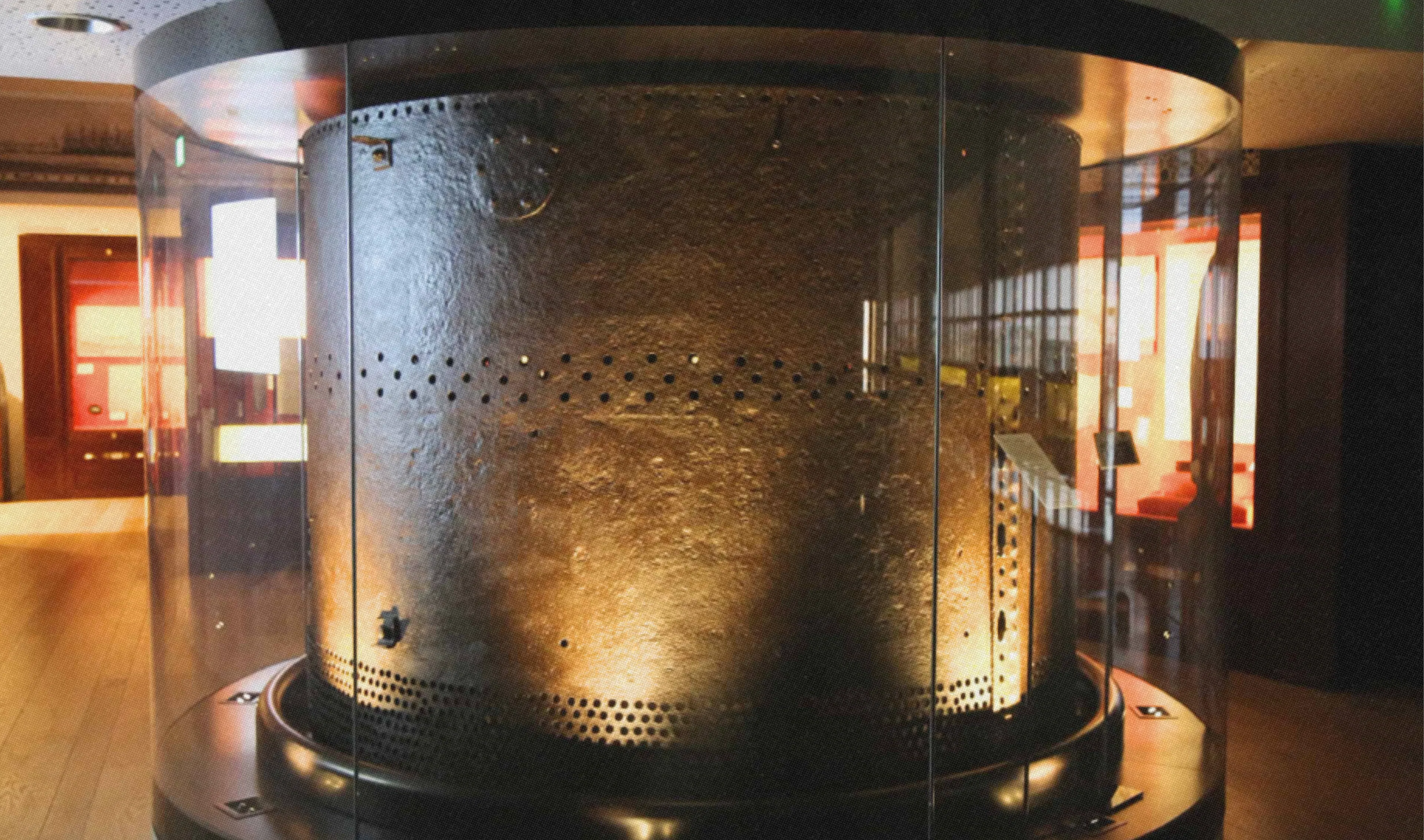
Here is the forward funnel from Isambard Kingdom Brunel’s third and final ship, the SS Great Eastern. Positioned nearest the bow, it is now one of the few surviving pieces of this remarkable vessel.
When built, the SS Great Eastern had five funnels serving its two engines. One engine powered two enormous paddle wheels on either side of the ship, while the second engine drove a screw propeller. Both systems were needed to propel the vast iron ship through the water.
Constructed from iron and held together with rivets, the funnel was badly damaged during an explosion on the ship’s first voyage, on 9 September 1859. After the incident, the damaged funnel was removed at the nearest port, Weymouth. The Weymouth Waterworks Company purchased this section, later drilling multiple holes into it and repurposing it as a water strainer.
Maiden Voyage
The SS Great Eastern was launched onto the River Thames in January 1858, and much of the following year was spent fitting out the ship’s interior for passengers. In September 1859, it began its maiden voyage from London to Holyhead. But as it travelled along England’s south coast, disaster struck.
In the rush to prepare for departure, a temporary stopcock on a heating tank beside the funnel had been left closed. Pressure built up inside the casing, causing the front funnel to explode violently. The blast tore apart the deck and hurled part of the funnel into the air. Scalding steam and debris filled the boiler room, killing five crew members and injuring many more.
After the wounded were taken to the ship’s surgeons, the remaining engine was inspected to ensure the ship was safe. The SS Great Eastern then limped toward Weymouth.
Without any way to communicate at sea, news of the accident did not reach the public until the ship arrived in the harbour with its flags at half‑mast and one of its funnels missing. Crowds had gathered, expecting to see the impressive new vessel, but instead witnessed the aftermath of tragedy.
Brunel, already seriously unwell, died only days after hearing the news, on 15 September 1859. A formal investigation was held into the explosion, but it could not determine who was at fault.
The End of the SS Great Eastern
Despite the catastrophe, the SS Great Eastern was repaired and later used as a passenger liner between Britain and North America. It was then converted into a cable‑laying ship, playing a key role in laying the first successful transatlantic telegraph cable in 1866.
After its working life ended, the ship lay moored off the coast of South Wales for several years, its size making it difficult to repurpose. In 1885, it was sold to a Liverpool department store, which moved it to the River Mersey and used it as a floating attraction and advertisement. This venture was short‑lived, and by 1888, just 30 years after its launch, the SS Great Eastern was sold for scrap.
The ship had been constructed using over three million rivets, binding together two iron hulls, one inside the other. This made her exceptionally strong, but also extremely difficult to dismantle. It took 200 men nearly two years to break the ship apart. Some of the rivets removed during the process were later sold for charity for one shilling each.
Of Brunel’s three ships, only the SS Great Britain survives today. In the 19th century, ships were rarely preserved once they were no longer useful; Brunel’s first ship, the PS Great Western, was scrapped in 1856 despite its historic achievement as the first purpose‑built transatlantic steamship. Today, vessels like the SS Great Britain and other structures with remarkable histories are often preserved so their stories can continue to be told.