The SS Great Britain Homecoming, 1970
The picture
After 47 voyages and 88 years in service, SS Great Britain was scuttled in the Falkland Islands in 1937, having been deemed too unsafe and costly to maintain.
- In 1969, a £150,000 rescue mission led by British naval architect Ewan Corlett set out to return Brunel’s ship to Bristol, where she was built.
- Carried across the Atlantic on a giant floating pontoon, the ship travelled 8,000 miles in nearly three months.
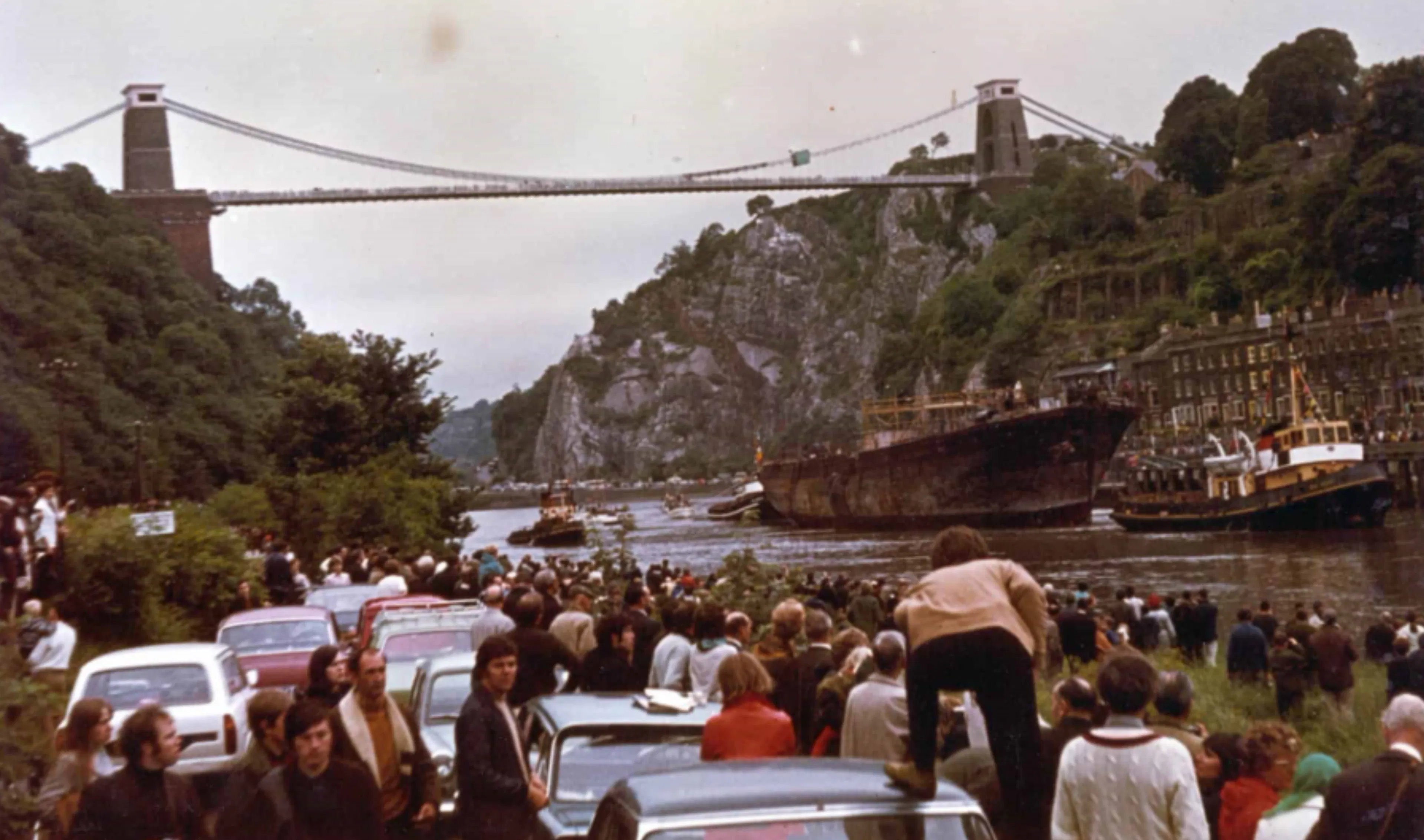
- In July 1970, she was towed up the River Avon and beneath the Clifton Suspension Bridge, watched by an estimated 100,000 people who gathered to witness her return.
Homecoming
On 5 July 1970, SS Great Britain was taken off her pontoon, re‑floated and towed upriver into Bristol. It was the first and only time she passed beneath the completed Clifton Suspension Bridge, which had not been finished when the ship left Bristol in the 1840s.
On 19 July 1970, she returned to the Great Western Dockyard, exactly 127 years after her launch. Since then, the ship has undergone extensive restoration and today welcomes around 175,000 visitors each year, sharing the stories of those who travelled and worked aboard her as part of the SS Great Britain Experience.
A long working life
Designed by Isambard Kingdom Brunel and launched in 1843, SS Great Britain was hailed as “the greatest experiment since the Creation”. Combining an iron hull with a steam‑powered propeller, she was the largest and strongest ship of her time.
Originally built as a luxury transatlantic liner, she later carried passengers to New York and Australia, before being converted to carry cargo in 1882. By 1886, the ship was considered unsafe at sea and was later used as a floating store.
Rescue and return
In 1937, SS Great Britain was abandoned at Sparrow Cove in the Falkland Islands, where she deteriorated for decades. Inspired by the ship’s story, Ewan Corlett appealed in The Times in 1967, arguing she was as significant as the Cutty Sark.
With wide public support and funding from philanthropist Jack Hayward, the rescue went ahead. In April 1970, divers re‑floated the ship, sealed her hull and secured her to a pontoon. On 24 April, she began the final 87‑day voyage home, completing one of the most ambitious maritime rescues of the twentieth century.
Discover more with our collections